Showing posts with label California. Show all posts

Monday, July 12, 2010

A house of mystery in San Jose


This past weekend we traveled 90 minutes north to San Jose to visit a friend of Jane's. She was attending a conference and had an afternoon free. By coincidence, we all went to tour an incredible house that has interesting links to a famous family from New Haven, Connecticut.


The Winchester Mystery House is a mansion that was under construction continuously for 38 years. It once was the personal residence of Sarah Winchester, the widow of gun magnate William W. Winchester. The mansion is renowned for its size and utter lack of any master building plan. Under Sarah Winchester's personal and direct day-to-day guidance, its "from-the-ground-up" construction proceeded around-the-clock, without interruption, from 1884 until her death on September 5, 1922, at which time work immediately ceased. The cost for such constant building has been estimated at about US $5.5 million (this would be equivalent to almost $70 million in 2008 dollars).

An aerial view of the massive Winchester House. Click on the photo to see it in a larger size.
 
Here is a little background edited from the website of the house that explains who built the house and why.

Sarah Lockwood Pardee was born in 1840, the daughter of Leonard Pardee and Sarah Burns, a carriage manufacturer in New Haven, Connecticut.  Known as the "Belle of New Haven," Sarah enjoyed all the advantages of a cultured upbringing, including an education at the best private schools. She spoke four languages and played piano beautifully.  In 1862, Sarah married William Wirt Winchester, son of Oliver Fisher Winchester, owner of the company that made the famous Winchester repeating rifle. 
 
The couple's life together was happy, and they moved in the best New England society. However, in 1866, disaster struck when their infant daughter, Annie, died of then mysterious childhood disease. Mrs. Winchester fell into a deep depression from which she never fully recovered.  Fifteen years later, in March 1881, her husband's premature death from tuberculosis added to Mrs. Winchester's distress.  Deeply saddened by the deaths of her daughter Annie in 1866, and her young husband in 1881, and seeking solace, Winchester consulted a medium on the advice of a psychic.  According to popular history, the medium told Winchester that she believed there to be a curse upon the Winchester family because the guns they made had taken so many lives.   The psychic told Winchester that "thousands of people have died because of it and their spirits are now seeking deep vengeance." Although this is disputed, popular belief holds that the Boston Medium told Winchester that she had to leave her home in New Haven and travel west, where she must "build a home for yourself and for the spirits who have fallen from this terrible weapon, too. You must never stop building the house. If you continue building, you will live forever. But if you stop, then you will die."


Winchester inherited more than $20.5 million upon her husband's death. She also received nearly 50 percent ownership of the Winchester Repeating Arms Company, giving her an income of roughly $1,000 per day, none of which was taxable until 1913. This amount is roughly equivalent to about $22,000 a day in 2010.  All of this gave her a tremendous amount of wealth to fund construction.


Mrs. Winchester packed her bags and left Connecticut to visit a niece who lived in Menlo Park, California. While there she discovered the perfect spot for her new home in the Santa Clara Valley. In 1884 she purchased an unfinished farm house just three miles west of San Jose. She immediately hired carpenters to work in shifts around the clock. By the turn of the century the eight-room house had grown into a seven-story mansion.

Old postcard view of the mansion prior to the 1906 earthquake.
 
The house was badly damaged by the 1906 San Francisco earthquake and subsequent repairs removed the top three stories leaving it as it is today with only four stories. After 38 years of non-stop, unrelenting construction the mansion had grown to such a size to ramble over six acres. The house contained 160 rooms, including 40 bedrooms and 2 ballrooms, one completed and one under construction, 13 bathrooms, and 6 kitchens. There were over 2,000 doors, 10,000 windows, 47 stairways, 47 fireplaces linked to 17 chimneys. Several of the doors and stairways lead nowhere as the house lacked a coordinate plan. Before the availability of elevators, special "easy riser" stairways were installed to allow Winchester access to every part of the mansion to accommodate her severe arthritis. Roughly 20,500 gallons (76,000 liters) of paint were required to paint the house. Due to the sheer size of the house, by the time every section of the house was painted, the workers had to start repainting again. The house also has many conveniences that were rarely found at the time of its construction, including steam and forced-air heating, modern indoor toilets and plumbing, push-button gas lights, a hot shower from indoor plumbing and even three elevators.


Mrs. Winchester's elegant Grand Ballroom is built almost entirely without nails. It cost over $9,000 to complete at a time when an entire house could be built for less than $1,000.  The silver chandelier is from Germany, and the walls and parquet floor are made of six hardwoods – mahogany, teak, maple, rosewood, oak, and white ash. The most curious element of the Grand Ballroom are the two leaded stained glass windows, each inscribed with a quote from Shakespeare. The first, "Wide unclasp the table of their thoughts," is from Troilus and Cressida (IV:5:60). The lines are spoken by Ulysses, and refer to Cressida's sometimes flirting nature. The second, "These same thoughts people this little world," is from Richard II (V:5:9). The imprisoned Richard means that his thoughts people the small world of his confinement. Nobody knows for certain what these lines meant to Mrs. Winchester. While they apparently held some special meaning for Mrs. Winchester, their significance remains a mystery today. Ironically, the ballroom was probably never used to hold a ball. According to one story, Mrs. Winchester once heard that a celebrated orchestra was performing in San Francisco. She invited the musicians to play at her home, but scheduling conflicts prevented the visit. In any case, Mrs. Winchester sealed off the ballroom after the earthquake of 1906.

 
While she sometimes drew up simple sketches of the building ideas, there were never any blueprints….or building inspectors. In the morning, she would meet with John Hansen, her dutiful foreman, and go over new changes and additions. During the early years of construction, this resulted in some awkward and impractical concepts such as columns being installed upside down. John Hansen stayed with Mrs. Winchester for many years, redoing scores of rooms, remodeling them one week and tearing them apart the next. This resulted in many features being dismantled, built around, or sealed over. Some rooms were remodeled many times. It is estimated that 500 rooms to 600 rooms were built, but because so many were redone, only 160 remain. This naturally resulted in some peculiar effects, such as stairs that lead to the ceiling, doors that go nowhere and that open onto walls, and chimneys that stop just short of the roof!

 
The only known photo of Sarah Winchester.  Insistent on privacy, this photo was reported to have been taken by a gardener hiding in the bushes.


Mrs. Winchester passed away in her sleep from heart failure on September 5, 1922. At the time of her death, all work abruptly stopped. Carpenters even left nails half driven when they learned of Mrs. Winchester's death. She was buried at the Evergreen Cemetery in New Haven, Connecticut beside her beloved husband. According to the provisions of her will, Mrs. Winchester's personal property, including the furnishings, household goods, pictures, jewelry, and papers were left to her niece, Mrs. Marian Merriman Marriott, who promptly had the furnishings auctioned off. It is said to have required six trucks working six weeks to cart the furnishings away. The mansion and farm were not mentioned specifically in the will. They became part of Mrs. Winchester's estate and were sold by her trustees, the Union Trust Company of San Francisco. Sarah Winchester made no mention in her will of the mansion, and appraisers considered the house worthless, probably due to the un-repaired earthquake damage as well as the impractical nature of its design. It was sold at auction to a local investor for $135,000 and in February 1923, five months after Mrs. Winchester's death, the house opened to the public. Today the home is owned by Winchester Investments and it retains unique touches that reflect Winchester's beliefs and her reported preoccupation with warding off malevolent spirits. These spirits are said to have directly inspired her as to the way the house should be built. The number thirteen and spider web motifs, which had some sort of spiritual meaning to her, reappear around the house. For example, an expensive imported chandelier that originally had 12 candle-holders was altered to accommodate 13 candles, wall clothes hooks are in multiples of 13, and a spider web-patterned stained glass window contains 13 colored stones. The sink's drain covers also have 13 holes.


  The tour was fascinating, bizarre, and an incredible wander through a unique monument to mental illness. The tour guide warned people not to stray from the group or they could be lost for hours. We walked well over a mile through twisting hallways, made even more intriguing by secret doors and passageways in the walls. We were told that Mrs. Winchester traveled through her house in a roundabout fashion, supposedly to confuse any mischievous ghosts that might be following her. I was left with the impression that she was certainly a very rich but also very troubled woman. Her legacy is a house unlike any ever built, or likely ever to be built in the future. If you are ever in San Jose, I highly recommend a visit and tour of the Winchester Mystery House.


Wednesday, June 30, 2010

Kings Canyon and Sequoia National Parks

On the first weekend of June, Jane I headed away into the Sierra Nevada Mountains to visit two spectacular national parks. A long four hour drive to get there started with heading north from Monterey by following US Highway 101 north until Gilroy, the self proclaimed Garlic Capital of the world.

  Farm fields near Gilroy.

Onwards now heading east following California Highway 152, passing the large Sisk Dam and San Luis Reservoir.  This is a fairly interesting place as it is the largest off-stream reservoir in the US.  A massive earth dam, 300 feet tall and over 3.5 miles long holds an enormous amount of water, yet it receives barely any of it from one very small stream.  It gets the vast majority of its water from the Sacramento River Delta where to prevent the water being "wasted" by flowing into the ocean it is captured and then pumped hundreds of miles up-hill and inland to the San Luis Reservoir where it can be stored until being sent via the massive California Aqueduct to various cities and agricultural irrigation projects. 


We carried on before stopping for lunch at a roadside takeout restaurant in the amusing named Los Banos (Spanish word for bathrooms or toilets).
The Spanish monk and explorer Padre Felipe Arroyo de la Cuesta was stationed at Mission San Juan Bautista from 1808 to 1833. On his missionary visits to the Native Americans he discovered pools of water in a little creek bed that flowed down into the San Joaquin Valley. At these baths or pools he camped overnight with his band of friendly Indians from the Mission. Reports of these baths led to the local ranchers naming the creek "El Arroyo de Los Banos del Padre Arroyo"  (which translates as 'the creek where the pools or baths and camping place of Padre Arroyo').  In time that lengthy name was reduced to "Los Banos Crick." In 1873 a pioneer to the area named Gus Kreyenhagen ran a trading post near Los Banos Creek. The Post Office Department decided to establish a Post Office at the trading post and named it after the creek, hence the name "Los Banos."


On east following Highway 152 until it intersected with California Highway 99 which we followed south to Frenso which looked every bit as large as the reported 1 million metro population (making it the 5th largest city in the state). Here we swung east once more now following the very scenic California Highway 180 which we would eventually travel to its terminal deep inside Kings Canyon.


We followed the steeply climbing highway, entered into Kings Canyon National Park, and immediately paid a visit to the Visitors Center.  After a fairly quick look at the somewhat tired and dated displays we resumed our driving following the Scenic Byway road that heads deep into the park.

Heading into the South Fork of the Kings River - note the road far below.
The road into the heart of Kings Canyon - an impressive feat of engineering.

Finally we reached the South Fork of the Kings River which was very much in flood with the spring melt of snow from the highlands.
The raging South Fork of the Kings River - note the trees in the flooded steam bed.

The flooded river was threatening to force a closure of the road - something we were warned about at the visitors center. There is something frightening above a river in flood and standing on its banks you cannot help be impressed but by the enormous power.  But also fully aware of the awesome destructive force.  Several people are killed each year in this national park by the snow melt flooded rivers.


At the end of the road sheer granite cliffs rose up on both sides of the valley.
 

We did a short walk to Muir Rock – so named because environmentalist, John Muir used to deliver impassioned speeches about the need to protect the Sierra Mountain Range from this rock beside the river.  The approach must have worked - because in 1890 the first portion of the current park was established to protect the giant sequoia trees,  making this America's second oldest national park. 

 Tree shadow on Muir Rock.

We drove back to the Visitor Center enjoying the amazing colors of the late afternoon sunlight on the canyon walls and passing large patches of snow still lingering beneath the trees.  It was clear to see that the river was still rising.


Lone Pine tree growing on cliff ledge.


We now made our way to the Grant Grove. This section of Kings Canyon National Park was established to protect a grove giant sequoia trees. It includes the General Grant tree, the second largest tree in the world. Grant Grove covers a little over 154 acres.


This tree was named in 1867 after Ulysses S. Grant, Union Army general during the Civil War and the 18th President of the United States (1869-1877). President Calvin Coolidge proclaimed it the "Nation's Christmas Tree" on April 28, 1926. On March 29, 1956, President Dwight D. Eisenhower declared the tree a "National Shrine", a memorial to those who died in war.  It is the only living object to be so declared.  The tree is the second largest tree in the world after the General Sherman tree as of 2005, when the Washington tree, which was previously in second place, lost half its trunk. Once thought to be well over 2,000 years old, recent estimates point to a much younger age closer to 1,650 years. 

The General Grant Tree was an absolutely impressive sight to see.  The eastern side has a huge burn scar from an ancient lightning strike.  The diameter at ground level is a staggering 40.3 feet (12.3 m) making it the largest diameter tree known in the world.  It would take 20 people holding out stretched hands to make a complete circle around the base. The Grant Tree has a volume of 46,608 cubic feet (1,320 cubic meters).

The walk through this grove of massive tress is incredible.  There are many other named trees in this grove including several named after US States.  The California Tree had an impressive diameter of 22 feet whereas, Minnesota was somewhat smaller at 10 feet.  But still, a tree with a diameter (meaninng if you cut it down the distance across the widest part of the stump) of 10 feet is still very large.

  In the Grant Grove.

After an over-priced but tasty dinner at the restaurant beside the visitors center we used the car headlights to pitch the tent in the dark and enjoyed a relaxing night’s sleep beneath the forest giants.
Our wonderful campsite beneath the towering trees.  The brown metal box is to keep all food inside over night to keep the bears from breaking into tents and cars.

Poster warning of what happens when you do not use the bear box to store food.
Next morning we headed for neighboring Sequoia National Park. Here is a little information from Wikipedia on these phenomenally massive trees.

Sequoiadendron giganteum (Giant Sequoia) is the sole living species in the genus Sequoiadendron, and one of three species of coniferous trees known as redwoods. Giant Sequoias are the world's largest trees in terms of total volume. They grow to an average height of 50–85 m (165–280 ft) and 6–8 m (18–24 ft) in diameter. Record trees have been measured to be 94.8 m (311 ft) in height and 17 m (57 ft) in diameter. The oldest known Giant Sequoia based on ring count is 3,500 years old.  Sequoia bark is thick and protects the tree – it can be almost a meter (3 feet) thick. The natural distribution of giant sequoia is restricted to a limited area of the western Sierra Nevada mountains in California.  It occurs in scattered groves, with a total of 68 groves recorded. Nowhere does it grow in pure stands with a mixture of other pine and conifer species. Groves range in size from 1,240 ha (3,100 acres) with 20,000 mature trees, to small groves with only six living trees. Giant sequoia is usually found in a humid climate characterized by dry summers and snowy winters. The elevation of the giant sequoia groves generally ranges from 1,400-2,150 m (4,600-7,000 ft). The wood from mature giant sequoias is highly resistant to decay, but is fibrous and brittle, making it generally unsuitable for construction. From the 1880s through the 1920s logging took place in many groves in spite of marginal commercial returns. Due to their weight and brittleness trees would often shatter when they hit the ground, wasting much of the wood. Loggers attempted to cushion the impact by digging trenches and filling them with branches. Still, it is estimated that as little as 50 percent of the timber made it from groves to the mill. The wood was used mainly for shingles and fence posts, or even for matchsticks. Pictures of the once majestic trees lying logged, broken, and abandoned in formerly pristine groves, added with knowledge that the wood would be put to such modest use, spurred the public outcry that caused most of the groves to be preserved as protected land.
Looking into the Redwood Mountain Grove - the worlds largest grove of the worlds largest tree.  Over five square miles containing over 2,100 sequoia with a diameter of 10 feet or greater.

We carried on driving through the forest on twisting narrow roads to visit Hume Lake.
This may look the very definition of the best of nature - but in fact the lake is man-made.  It was created to have a reservoir to float logs down a 62 mile flume, the worlds longest.  Believe it or not, adventurous people would even ride the flume in specially designed boats.  When the logging operations ceased the property was bought by a christian camp which runs all sorts of programs from this incrediblly beautiful spot.


Onwards further into the park where we found snow lingering at the higher elevations and the distant peaks still covered in snow.  Not surprising given that many years a 40 foot snow pack blankets the upper reaches of the Sierra Nevada Mountains.

We now headed to the Giant Grove which is home to the worlds largest tree.
 
The General Sherman with a height of 275 feet (83.8 metres), and volume of its trunk of 1,487 cubic meters, is the world’s largest tree (and the largest living thing on the planet). The tree is believed to be between 2,300 and 2,700 years old. In 1879, it was named after American Civil War general, William Tecumseh Sherman, by naturalist James Wolverton, who had served as a lieutenant in the 9th Indiana Cavalry under Sherman. In 1931, following comparisons with the nearby General Grant tree, General Sherman was identified as the largest tree in the world. One upshot of this process was that wood-volume was widely accepted as the defining factor in establishing the world's largest tree.

The General Sherman Tree. Click on the photo above, then look really close on the right hand side and you will see people to give a sense of the size of this massive tree.
 
As many of my New Zealand family and friends are reading this I tought I would provide a point of contrast with the General Grant Tree to Tāne Mahuta, the giant Kauri which is the largest tree in New Zealand.

Battle of the Big Trees: USA versus New Zealand
General Grant Tree – Giant Sequoia  versus Tāne Mahuta – Giant Kauri
Height:  275 feet (84 meters) versus 168 feet (51 meters)
Circumference of trunk: 103 feet (31.3 meters) versus 45.2 feet (13.7 meters
Age (estimated): 2,300- 2,700 years versus 1,250, 2,500
Estimated volume : 52,508 cubic feet (1,486.6 cubic meters) versus 18,247 cubic feet (516.7 cubic meters)

So, put another way, almost three Tāne Mahuta kauri trees would fit inside the General Grant.

The trunk of the General Sherman (people of left for scale).
 
I needed to back up a long way to get the whole tree in a single photo.  If you have really good eyes you can see people around the base - they look like ants.

Trail on the way out from the Giant Grove passes through the log of a fallen sequoia.
 
It was now quite a warm day so we took the cheaters approach rather than walking the mile back uphill to the car we caught a convenient free shuttle bus back to the car park.
Back on the road I caught something out the corner of my eye and pulled over for a closer look.  It proved to be a black bear and her cub feeding on the spring grasses.  This is the closest I've been to a bear in all my years in the US.  A fabulous experience to watch this powerful animal and her super cute little cub mostly hidden behind the trees.

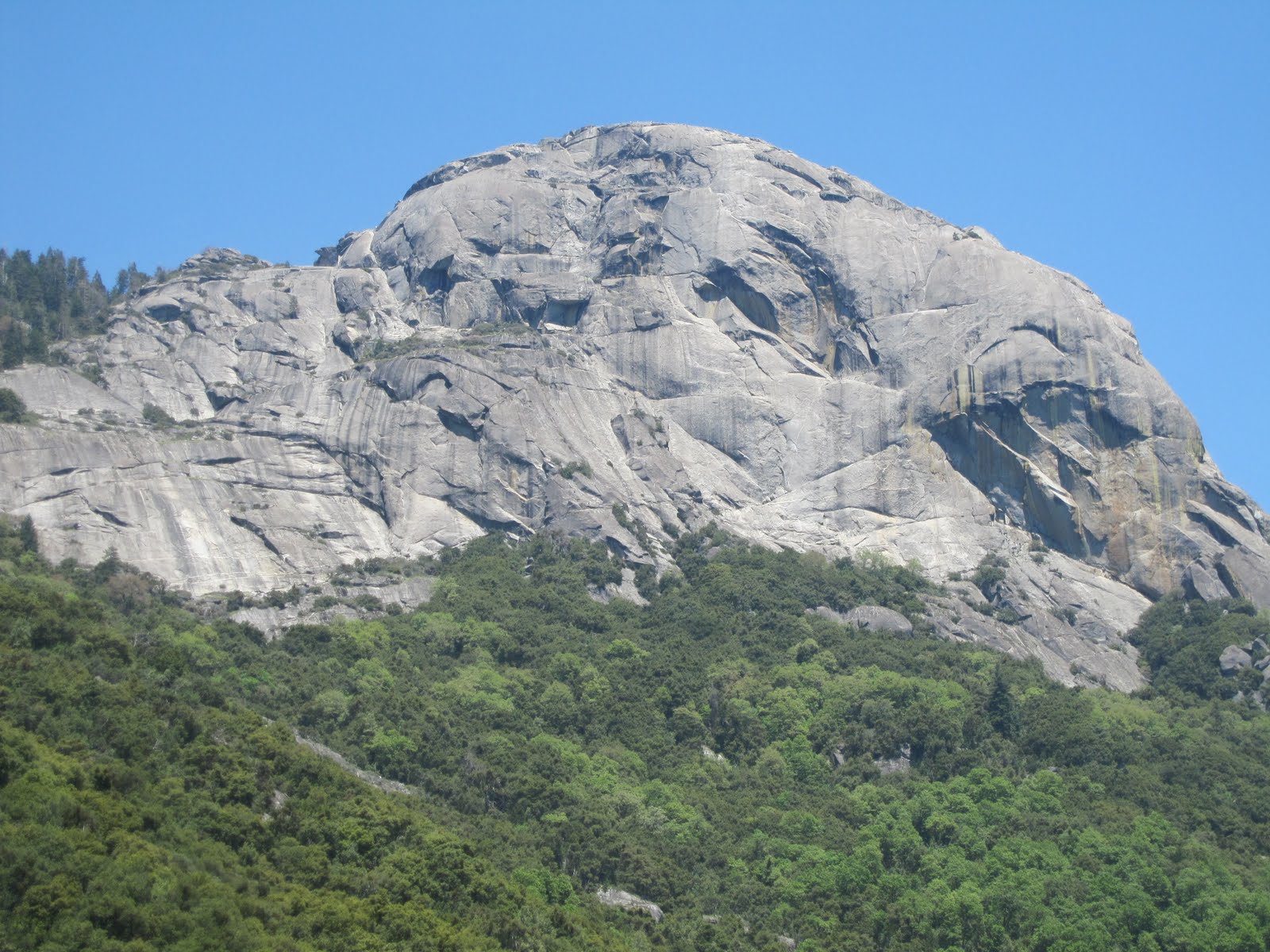
The next stopping place was Moro Rock - a huge granite dome standing on the southern rim of the Giant Forest plateau. It somewhat resembles Half Dome in Yosemite National Park, except that this is a whole dome. Common in the Sierra Nevada, these domes form by exfoliation, the casting off rock layers on otherwise smooth unjointed granite. This occurs as a result of the slow expansion of the granite rock and ultimately results in rounded dome-like forms.
 

The summit elevation of Moro Rock is 6,715 feet. The eastern, southern, and western faces of the rock are precipitous cliffs over a thousand feet in height that attract the world’s top rock climbers. The northern side of the rock is connected to the Giant Forest plateau by a granite ridge. The Moro Rock Stairway has 400 steps that follow this ridge and lead to the summit of the peak.

 Setting off to climb Moro Rock.


The 797-foot-long stair was designed by National Park Service landscape architect Merel Sager and engineer Frank Diehl, and was built in 1931, following natural ledges and crevices using labor from the Civilian Conservation Corps. It replaced a wooden stairway built in the 1920s that had deteriorated dangerously. Unlike the earlier stairway, the new stairway adopted a design policy of blending with the natural surfaces to the greatest extent possible. For this reason it was added to the National Register of Historic Places.


Use of this trail is discouraged during thunderstorms as several deaths have occurred from lightening strikes.


The views from the top were simply stunning - made more so by the day without a single cloud in the sky.

The view from the top of Moro Rock also provided a preview of the road we would traverse as we dropped off the plateau down to the follhills and into the Kaweah River Valley.

 The view from Moro Rock looking at the road down to the Kaweah Valley.

We ended our traverse of the National Parks by making a visit to the FootHills Visitor Center located next to the Park Headquarters.  It was a long, hot, dry journey home but it still provided several interesting sites to see.  Firstly, the citrus groves surrounding the very aptly name town of Lemon Cove, the flooded Lake Kaweah with water up to the roof of picnic shelters and bathroom blocks.  Then on through Visalia, Hanford, then Lemoore which is home to a massive US Navy Air Station.  We ate dinner at a 1950s themed diner in Coalinga that I'm not sure was decorated, but rather showing the last time any updating on the propety was done.  Up and over the very scenic California Highway 198 into Priest Valley which had it grass covered hills bathed golden in the evening light. Out to meet US 101 at San Lucas and then another hour and we were home.
 Evening light on the hills near Priest Valley.

 This was a fabulous weekend.  I've been in forests of all types but nothing compares to the majesty of standing in awe beneath the giants of Sequoia National Park.  To camp a night under these trees was an unexpected highlight.  So too Kings Canyon with its rock, raging river, and scenic byway cutting through to the heart of the Sierra Nevada Mountains.  John Muir was right when he said: "In every walk with nature one receives far more than he seeks." - John Muir